Heart Retro Font: Playful, Nostalgic Dingbats for Handmade Labels & Printables
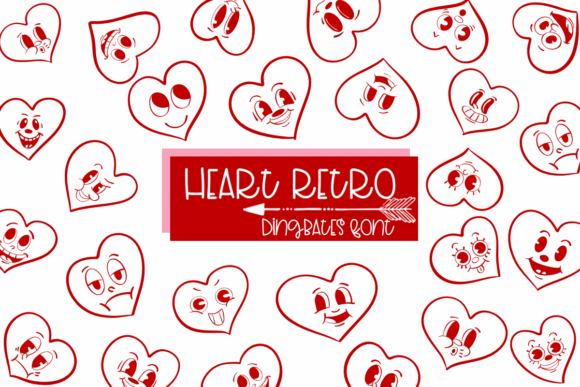
If you’ve ever spent hours tweaking a candle label to feel warm and inviting—or agonized over whether your wedding welcome sign reads “sweet” or just “confusing”—you know how much weight a single font choice carries. That’s why Heart Retro landed in my design folder and hasn’t left since. It’s not just another dingbats font—it’s a retro-style typeface where every letter is a cheerful, slightly wobbly smiling heart. Think 1950s diner signage meets childhood sticker books: rounded, friendly, unapologetically joyful.
As someone who sells printable planners, handmade soap labels, and seasonal SVG bundles on Etsy, I need fonts that work *twice*: once as visual charm, and again as functional design assets. Heart Retro delivers on both. Its characters are bold enough to cut cleanly on Cricut and Silhouette machines—even at 12–16pt—and the consistent stroke weight keeps small stickers and boutique tags legible without blurring. No pixelation on mockups, no jagged edges on vinyl cuts. Just smooth, nostalgic charm that translates across mediums.
I use Heart Retro most often for short, high-impact phrases: “Made with Love,” “You’re My Person,” “Hello, Sunshine,” or even simple names like “Emma” or “Leo” on baby shower invites. It’s not built for body text—no dingbats font is—but it shines as a display font for titles, headers, and decorative accents. On a farmhouse-style wooden sign? Perfect. On a kraft paper gift tag for artisan chocolates? Instant warmth. On a digital printable wall art set themed around self-love or friendship? It adds emotional resonance before the viewer even reads the words.
Real-world uses that have sold well in my shop include:
- Candle and bath bomb labels—paired with a clean sans serif (like Montserrat or Inter) for ingredients and safety info
- Wedding welcome boards and seating charts, especially for rustic, vintage, or garden ceremonies
- Digital planner stickers and habit tracker icons—Heart Retro spells out “Yes!”, “Try Again”, or “Celebrate” in a way that feels personal, not generic
- Seasonal product packaging: think Valentine’s Day soaps (“Be Mine”), Easter egg dye kits (“Hop Into Joy”), or holiday mugs (“Cozy & Covered”)
- SVG files for t-shirts, tote bags, and iron-on transfers—its thick, open shapes hold up beautifully in fabric print and heat transfer applications
Readability matters—not just for customers, but for production. I tested Heart Retro at 8pt on matte sticker paper: still recognizable, though best reserved for 10pt+ on physical goods. For digital downloads (like Canva-editable invitations or PDF planners), I recommend using it at 14–24pt for headlines and never smaller than 12pt for short phrases. Avoid cramming more than five words in a row—its personality is strongest when given room to breathe.
Font pairing is where Heart Retro truly sings. Because it’s expressive and thematic, it pairs best with neutral, highly legible companions. Try it with:
- A relaxed handwritten font (like Brittany or Waiting for the Sunrise) for greeting cards—Heart Retro handles the title, the script carries the message
- A crisp sans serif (like Open Sans or Poppins) for product labels—clarity + charm in one layout
- A subtle serif (like Playfair Display or Lora) for wedding stationery—elegance grounded by playfulness
Heart Retro comes as a standard OTF file—no extra weights or stylistic sets, which keeps things simple for crafters who don’t need complexity. It includes uppercase letters only (as expected for a dingbats font), plus basic punctuation and numerals—all designed with consistent spacing and optical alignment. No ligatures or swashes to manage, no multilingual glyphs to second-guess. What you see is what cuts, prints, and sells.
Commercial licensing is straightforward—and essential to note if you’re selling physical products or digital assets. Heart Retro is cleared for commercial use: that means you can embed it in printable templates, use it in SVG designs for cutting machines, apply it to mugs, shirts, and stickers you sell, and even include it in client branding packages. Just avoid reselling the font file itself or claiming it as your own creation. As long as you’re using it to build *your* products—not redistributing the font—you’re covered.
What makes Heart Retro stand out isn’t just its retro hearts—it’s how reliably it bridges aesthetic and utility. In a market flooded with overly ornate scripts and sterile geometric fonts, it offers something rare: instant recognition, emotional clarity, and production-ready consistency. Customers notice it. They pause. They smile. And then they click “Add to Cart.” Whether you're designing a $3 digital quote poster or a $45 custom wedding suite, Heart Retro adds that handmade sincerity—without sacrificing polish.
It’s become my go-to for any project where warmth needs to be visible at first glance. Not as decoration, but as intention.